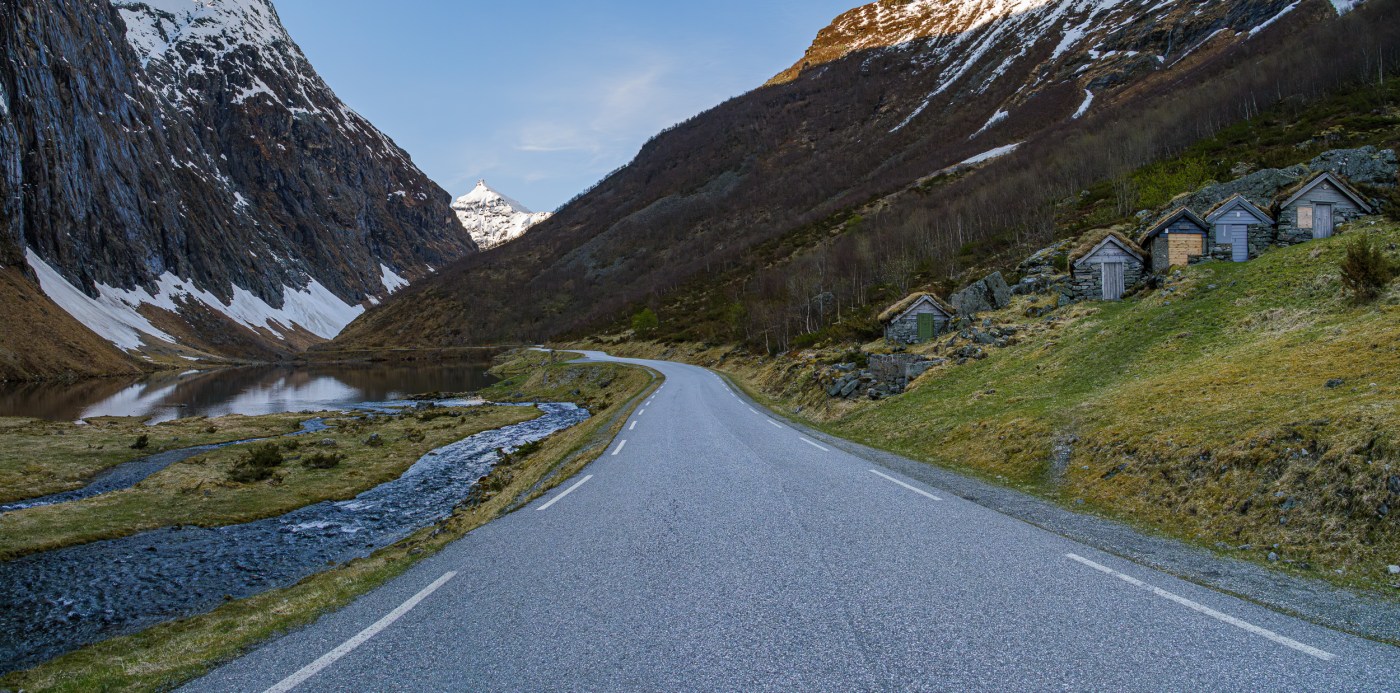
Like on most of my vacations, I took a lot of photos. None were terribly planned or thoughtful in the sense that I didn’t scout locations or show up during golden hour, but I can adapt pretty well to whatever conditions present themselves and compose and frame something decent most of the time. At least I think so.
We’ll start out with these gorgeous little huts on the side of the road leading to Oye which is where we spent the first three nights of our time there. This is a 2-image stitch of the road that goes through one of the narrowest valleys in the country (and one of the only one of those that has a road). It’s called Norangsdalen and is also one of the most beautiful and arresting. These huts are scattered throughout this region, but not many are so well preserved. This and another nearby are now historical landmarks. They were used by young women and girls who tended cows (and probably goats or sheep) that grazed up the mountains. The girls would lead them down, milk them and then deliver the milk to other folks to pick up and bring to town for sale or to be processed into butter or cheese. They slept in the huts overnight.
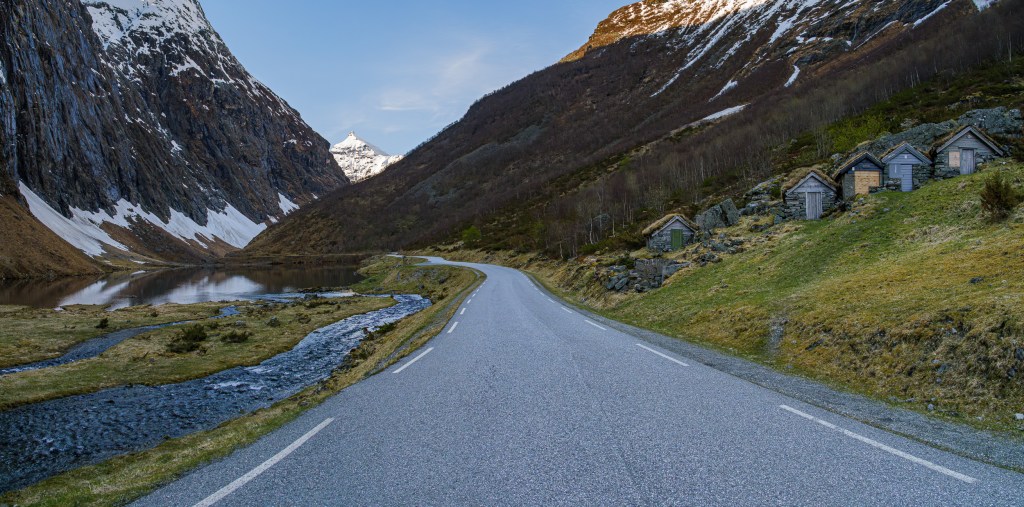
The word for them is setra or possibly seter (I believe, but it also seems to refer to a summer farm in general) and I was so excited to see them on Google maps when I was looking around our hotels and on the roads we’d take to other places and activities. Luckily this is the only way in and out of the town and so I had a couple of opportunities to work with them.

The light wasn’t wonderful, but I made it work. These first one were done when the sun was setting and because the valley is so steep and narrow, a lot of the slopes were in shade, but often the upper parts were brightly lit which make things a bit tough. I am really impressed with the amount of shadow recovery in the G9 M2 though. I deliberately underexposed so that when I couldn’t crop out the light parts, they wouldn’t be blown out or clipped.

It was pure coincidence that the little hut on its own was the most rustic or unimproved of the ones at this location. It is just so cute and I love the sod roof, a feature of so many buildings in Norway that I almost stopped seeing it after a couple of days. This shot features what might have been a storage building that hasn’t been kept as well as the cabins themselves. Talking to a woman we met later on who will have her own post, the reason might be that any wood used in the structure was taken and repurposed when the building no longer needed. Big trees are relatively rare in many valleys along these fjords and so precious. It reminded me of finding the remains of mining towns and camps in Death Valley. When the people moved on, they also took every scrap of usable wood with them since there isn’t any in the desert.


On another day when heading out, I got this photo of them in the morning sun. It’s basically the same view as everyone gets since they are so close to the road – there’s really only one way to shoot them easily. They are so cute though and built to last.

This wasn’t the only site featuring setras we saw on this road. There are others and all are now preserved as historical landmarks. All have signage and a sliver of parking, but none are roped off and even though we probably could have driven down to this next group, we decided to walk. Norway (and possibly European countries in general) have FAR fewer signs than in America. Sites like this here are littered with signs, ropes and notices about what you can and cannot do. Not so here.

In these views, taken from across the street at the site of yet more setras, you can see the remains of more buildings in the foreground. They are just rock foundations now, and might have been for more storage. The lake shore is just below in these views.

Husband and I walked up that path going behind the buildings and I spent a little time looking at the landscape and being awed at its rugged nature. These flowers are from the previous year, but still lovely and interesting. No idea what they are, but I saw them on the slopes of several mountains and they must be hardy plants indeed.

Here’s a little look at some ruins beside this last setra – not sure if it was another hut, which it probably was, or if it was storage. There is another crumbling one perpendicular to this one that you can see in the wider shots that might have been since it seems the sleeping quarters were built in rows with common walls. Either way it was picturesque and has a tangible connection to Noway’s past.

If you look at the doorframe you’ll see that it was once painted with bright colors, something that I’m sure was needed as a break from the monochrome of winter. Craving color is something I experience every spring and it seems pretty universal. We saw a lot of colorful murals, accents and designs all through older buildings. Other European countries have similar traditions and it’s sad that we’ve lost it in the US.


Here’s the lake I mentioned above. You can see the road and the huts in this for scale. The huts are at the bottom just left of center. There are two more setras just to the right of the curve in the road where you can see our rental car parked. This isn’t the greatest shot ever and I took only one knowing that the contrasty light would be difficult, but I think it works to show the valley and how amazing it is.

And finally a closer look at those two little cabins on the other side of the road. Again, the light was tough to deal with and I struggled to find a decent composition because these are stuck on basically a ledge on a very steep hillside. While coming down the path back to the car, I tried this composition and liked how it turned out. I think it tells the story of these little buildings and what life might have been like for the women using them.

So that’s it for this post. Many more to come.


Can you imagine living out here? The isolation could make you crazy. I once read about how a man on the plains of eastern Colorado went mad and murderous from the non-stop winds on the prairies. I get that way if the Santa Anas blow and blow and blow.
You caught the atmosphere here beautifully, as well as evoked a sense of place in both photo and words. I think the strong light contrasts of such deep valleys is so hard to catch because it is simply so much contrast. These buildings are amazing, and your comment about color in the spring makes sense. I don’t think the US has ever had a love of color in its architecture . . .
Looking forward to more!
Living in this area takes guts in some ways. The bigger cities and towns are one thing, but small villages with narrow, winding roads, avalanches and hard winters are another. I might like to try it since everyone we met was cheerful, centered and smart. There is little violence and so things like what you describe aren’t as common. Of course it is a smaller country and population and everyone is still human, but they seem to cope with weather and nature quite well. Isolation isn’t complete and there is a bond within and between small villages and holdings. They truly seem to come together. I’ll talk about that in my next post which I’m putting together now. Similar conditions and amazing scenery.
I think you are right about community being an important part of life in Norway. My understanding, too, is that the winters in Norway are not as severe as the ones in the midwest, at least historically. Community brings people together but the standard rugged individualism so prized here prevents the reaching out for help as it is seen as needy and wrong . . .
Beautiful images of this wonderful place. Norway is on our long list of places to visit so thanks for the virtual tour. (Suzanne)
It’s well worth a visit. We are not city people so wanted out-of-the-way locations and we got them. More posts coming up!