
While on our cruise of Hjørundfjorden, we visited an historical open-air museum owned by the lovely and enterprising Martina. During the summer, there are more activities and displays, but the one-on-one time with her was rewarding. This is definitely a case of being in the moment more than it was being a photographer for me, so the pictures are thin on the ground.
A translation for Bakketunet is hill yard or hill farm. Martina explained that when her ancestors first settled here in the mid-1500s, they were a fishing and farming family and built their home and other buildings directly on the shores of the fjord. The only problem was the grazing and planting fields were several hundred meters up the mountain slopes and trudging up and down was too time-consuming. As a response, they kept the buildings necessary for boats and fishing down below and moved everything else up the hill to their current location. The remnants of orchards and fields surround the buildings.

That’s a look into the compound with the house and a barn behind on the left and another barn, used for cattle (mostly oxen), on the right. Behind it is another barn used for sheep and goats. That barn had to be built in such a way that if a wolf got into the barn and killed a sheep, it couldn’t leave with it, so the floor is a few feet below the bottom of the door, like a shallow cellar hole. They used a plank to move the sheep in and once settled, they took the plank out. A wolf couldn’t jump up and out again with its prey, and even a dead sheep is a useful sheep. What a terror for the rest of them though. Sheep are pretty flighty at the best of times. Oy.
The house itself was added onto as the family grew with the nearest part being communal bedroom where everyone would pile in to sleep under blankets and furs. On the other end of the house is another communal room that had an open fire pit with only a hole in the roof to let the smoke out. That has since been filled in, but the sooty evidence remains.
The only heat was from a woodstove in the kitchen which is the middle part of the building. There we had some coffee with Martina and she talked about the decorations and paintings in all the rooms. Her mother did them and while I don’t have any photos (it seemed rude to be snapping away while she was talking), she painted a lot of colorful flowers over door panels, chair backs and other furniture and architectural features. She even painted the barn doors, but alas, the paint is now almost worn away. I can only imagine how refreshing they would be in the depths of a harsh Norwegian winter. The artistic talent was passed down to Martina who is a painter in her own right, but also exhibits other people’s work at Bakketunet. Because restoring and running the museum, painting, and showing art (not to mention raising two daughters) wasn’t enough, she decided to form a knitting company to produce handmade sweaters with unique designs local to the area. And she couldn’t even knit and had to hire women could could! One thing we noticed is that the enterprising spirit is alive and well in the people of Norway. You can see one of Martina’s paintings on the barn below. It features a woman in traditional bridal dress and because the long, buttoned sleeves of the blouse represented protection, she painted in a Covid mask to add to the theme.
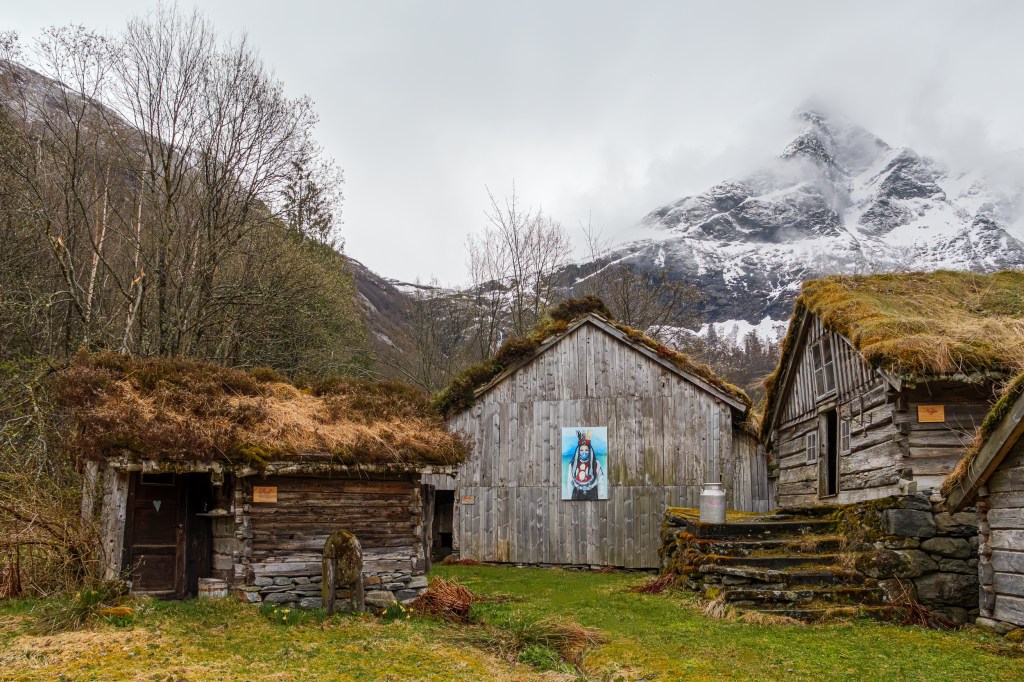
Like everywhere else on this fjord, the mountains loom close and resound with the roar of waterfalls. Here are a couple more views of that little building on the left –


It was just so darn cute and looks smaller at this end than it actually is. I think she said it was used to shelter their one horse back in the day. Her mother ended active farming here in the 1970s and until Martina decided to create a museum, it was falling to bits. Several of the buildings needed new roofs, but the government decided to step in to dictate just exactly how to go about it. Luckily some money came with that red tape and period-appropriate repairs have been done.
Next is the largest of the barns which is now used for live performances as well as movies with seating and a bar! Norwegians have their priorities. One of those is repurposing and recycling whenever possible, especially when resources are scarce, like large trees. The walls here were made with wood from a disused boat. The roof is original and has a thick layer of sod which not only insulates, but provides downward force to help solidify and steady structures during high winds. The timbers themselves were taken from old growth trees unaffected by acid rain and other pollution that makes today’s lumber less durable.

We were lucky to arrive when spring did. Lots of daffodils around the property.


So I hope you liked a look at a farm that hasn’t been changed much in hundreds of years and the work the latest descendants are doing to keep it together and bring it to us.


Leave a comment