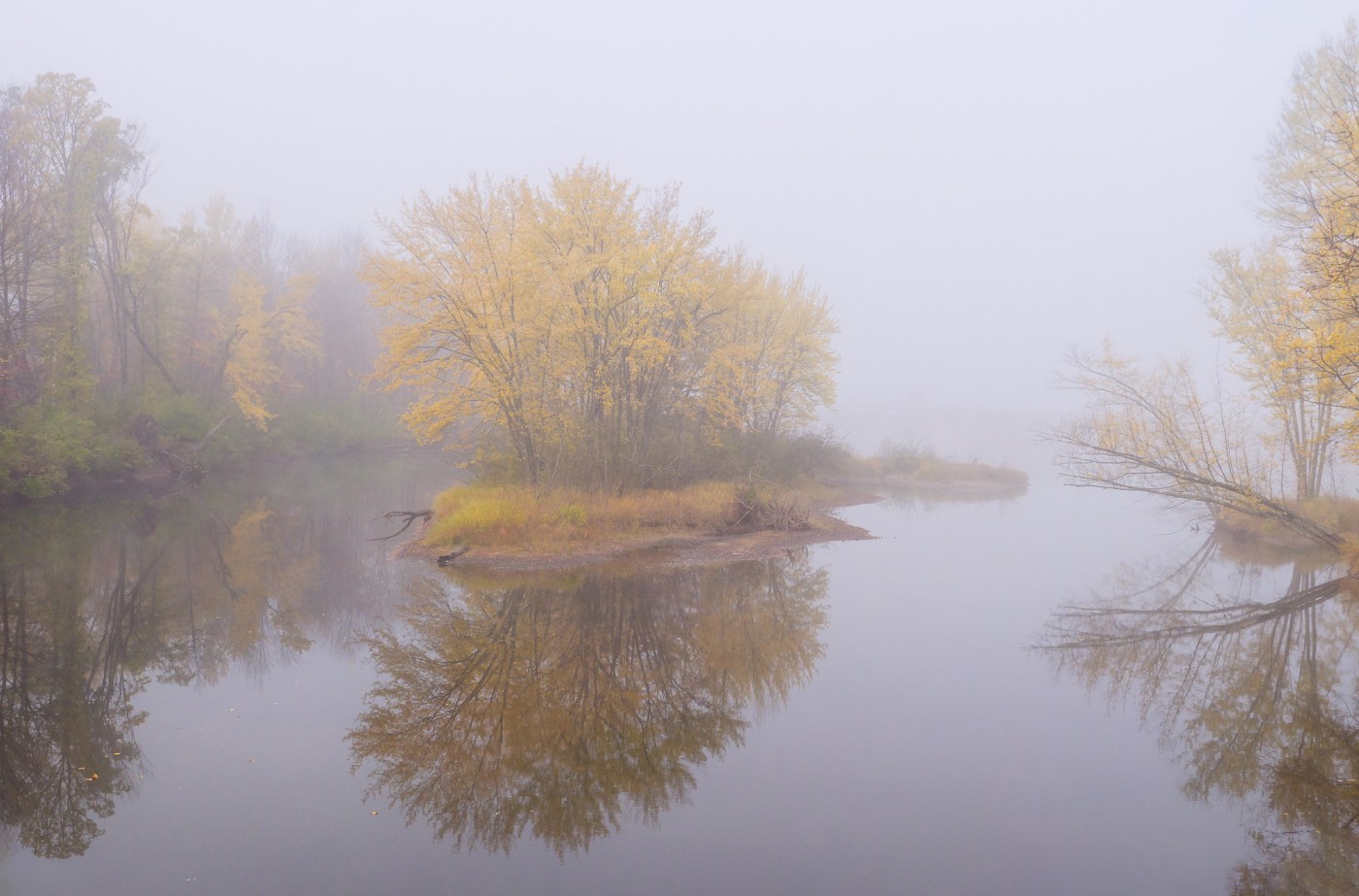
A while back I wrote about the importance of liking the process of photography and that for nature photographers at least, that’s not a problem. None of us would leave our warm, comfy beds in whatever weather at zero-dark-thirty to get photos if we didn’t like being out there. There is something about firsthand experience that lights up our brains and fills us with wonder and I wouldn’t trade it.
However, sometimes the demands of convention or fashion dictate a certain aesthetic to our photos that may not be possible to achieve in the field no matter how much fun we’re having. The pics in this post were all taken from a bridge over this bit of the Spirit river just below the dam that creates a big reservoir. The dam is nicely obscured by the fog and so that’s one reason I stopped for these. Creating a harmonious and balanced composition was hard since I was limited to the bridge.
It was almost a month before I processed any of these reflection images to a final version, or at least close to a final version. Deciding on which was “the one” stumped me. I dithered because I have these, plus more versions and couldn’t choose. So I processed them all similarly and then left them for a couple weeks.
When I went back to them, this one was the first I worked on. I did some Gen Fill and Remove tool work, but it became too static and distanced from the original scenario so to me it transformed to something alien and unfamiliar.
As you can see by the before and after shot below, I removed a rather large element of the scene. Being able to alter things in a major way has become an undercurrent of how I approach something in the field and during my initial assessment of a picture once I get it in Lightroom. Only recently has this ability to basically change anything I want, become something I think about all through my process – from setting up the composition on forward. So I pushed hard on that ability and replaced the trees on the right with plain fog at first, but it was too empty and weird. Filling in the Gen Fill prompt with some key words to get that little tree helped, but it took a while to get something that I liked even a little.

Slide left to see the after photo
I’m curious to hear your reactions because doing all this made me feel unsatisfied in the end. After thinking about it some more I can say that the dissatisfaction came when I yanked the photo too far out of my experience and made it something else. It felt like it wasn’t mine anymore, that I was taking the authenticity out of it and replacing it with something that might “work” better or adhere to certain principles of presentation and beauty, but that ultimately it didn’t belong to me anymore. Oh sure, the file came from my camera and the editing was my doing, but the connection to the experience was broken. The power of suggestion can alter memory and making a change this big was doing that to mine.
With AI driven images being so on the rise and able to produce “perfect” illustrations, I am left with the importance of the experience to savor. We nature photographers cherish that and go out in all kinds of weather conditions to be with the subjects that resonate with us. The ones that touch us and light up our brains. This scene did that and stripping away elements diminished that connection. As I’ve said before, I’m no purist when it comes to the Remove tool or the Healing brush, but I’m starting to feel that leaving in “imperfections” will be what sets apart true photography as art from photographic illustrations as art.
For this next version, instead of removing anything entirely, I changed the look of an existing thing so that it would be more harmonious with the rest of the vibe in the scene. Is it as egregious? Not in the way it makes me feel about this image. It still feels connected to me. It feels like mine. If I was a painter, I’d have put some foliage on those branches instead of leaving them bare. The foreground elements that were changed were actually worse than in these two versions; they were roadside weeds sticking up into the frame and would have gone no matter what the rest of the scene was doing. Again, if I was a painter, I wouldn’t have included them.


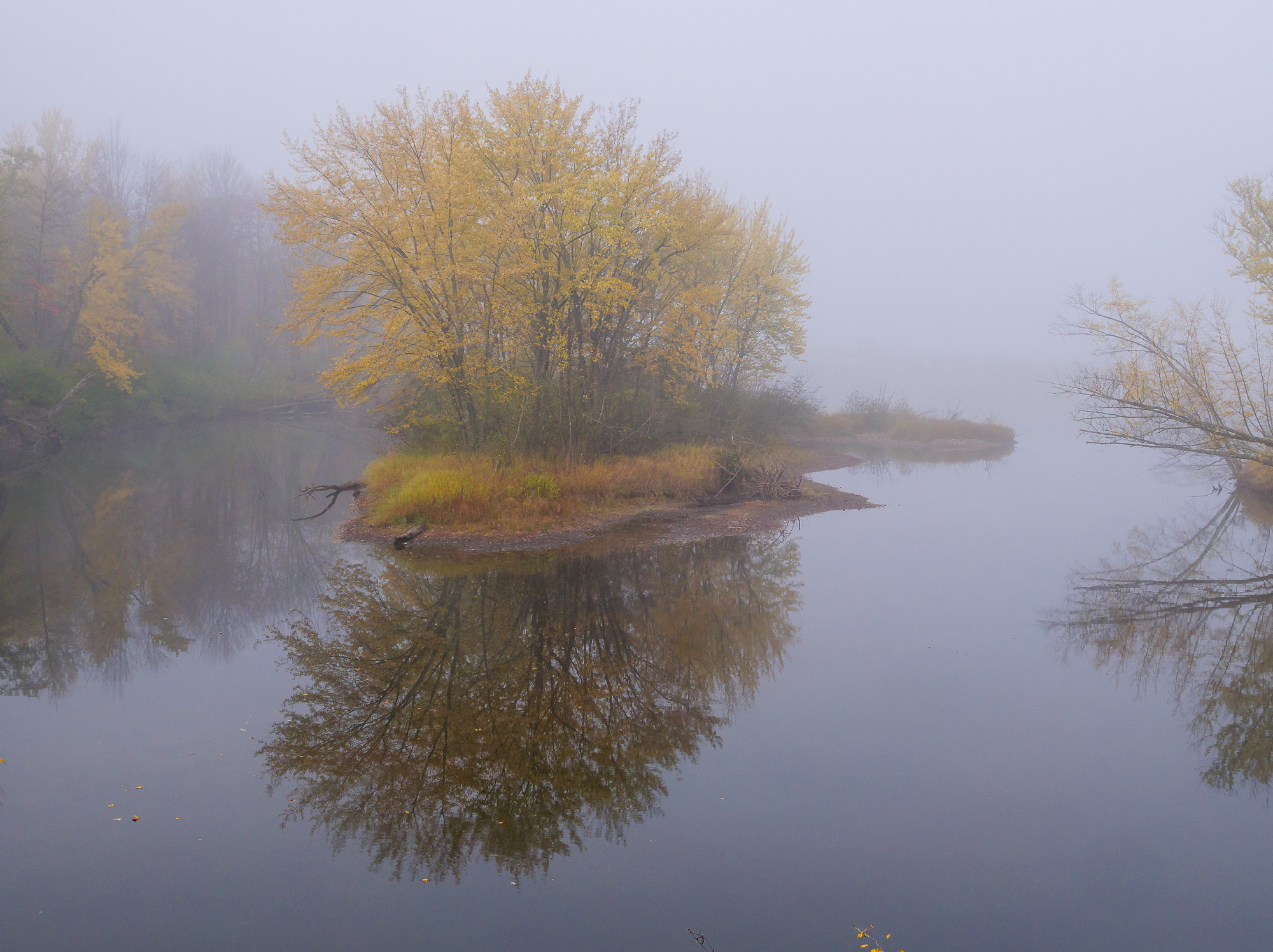
The last in this group was the one that needed the least amount of digital chicanery to work.

To me it’s fairly well balanced in terms of the elements of the scene and only needed some fiddling with a mask on the far right to de-emphasize that bunch of trees. By using some negative dehaze I faded it a bit to be more like the trees on the left that were further back in the scene, and thus more fogged. I also cropped away some of the heavy branches that give too much visual weight to that side of the frame and create some of the imbalance I’m feeling in the other two.
So what did I learn from all of this? That I’m not willing to sacrifice the experience that connects me to my images to satisfy some collective idea of what looks neat and uncluttered or follows popular rules of aesthetics (which are always changing anyway). That authenticity in my images comes from putting a viewer into my shoes. Cleaning away too many “blemishes” distances me and I assume viewers from feeling the full impetus of a photo. Making things too perfect completely severs my memory of what it was like being in front of whatever it was that made me stop in the first place.
Also, that the challenge of making a good image in the field is important to my satisfaction with my talent, my technical abilities and my sense of what makes an aesthetically pleasing picture. I have skills and I need to use them, to keep them sharp and not “cheat” my way out of a difficult composition or circumstance. That could be weather or light or people in my shot – whatever. Those are all part of being out and trying to create something from what is right in front of me. Backpedaling and saying “I can fix it in post” is just lame and does nothing to advance my technical knowledge or skill in composing or just plain seeing.
And seeing is what I crave. Seeing something wonderful and being able to remember that wonder through the photos I bring back. They don’t all have to be “perfect” or fall into some assembly line of monotony by forcing such stringent notions of what makes for a good photograph, but they all have to please me both in the making and in the presenting. Are you with me?


Lovely images. The fog is wonderful (Suzanne)
Thanks Suzanne! Fog is wonderful I agree and was so happy I made the effort to get out for it while it lasted.
Such a beautiful picture..love the fog!
Thanks so much. Fog is a photographer’s best friend and I think next week’s post features fog from the same outing, but a different location. And I didn’t get all philosophical on you again. At least I don’t think I did.
I’m a sucker for fog photos. And I don’t mind deleting things that I think interfere with the artistry of an image. It depends on whether your intention is to document reality vs creating something that appeals aesthetically. In the first photo with a slider, I for sure would have deleted the branches on the right because they are an interference not related to anything. I mind the branches less in other photos where you see more of the tree on the right, which “grounds” the branches.
Thanks Pat. It’s all context and story-telling right? But yeah, it has to look good. Sometimes the scene itself is working against both of those things. I try to keep it reasonably real and tell you when I do something really major.