
Most photographers I meet or talk to online are pretty wary of bringing their gear in a kayak. The biggest fear is of tipping and dumping themselves, and thousands of dollars worth of equipment, into the drink. If you’ve never been in a kayak and only recall videos of people doing kayak rolls, you’d think it was easy to do, but it really isn’t and kayaks are generally very stable and controllable. When I first bought my boat I took a class with Eastern Mountain Sports on kayaking basics. One of the lessons was how to get back in if you’ve fallen out in water over your head. The most valuable part of that was learning how difficult it is to tip my boat over. As a matter of fact I think most of the participants had a hard time doing it. It was that difficulty that gave me real confidence in the stability of the kayak.

So after over a decade of kayak photography I thought I’d put together a post about what I’ve learned, what I love, what still frustrates me and how I deal with it.

Love
First and foremost, I LOVE being on the water. There’s nothing like that first push from shore. The liquid freedom and silky movement that takes almost no effort. It’s freeing and puts me immediately into a whole different perspective and attitude. More than anywhere else I realize that I’m not in charge here, not in the same way I am on foot. On land things are more a meeting of equals and animals see and recognize us two-legged creatures for what we are; possible threats. On water our shape is different, we make less noise (mostly) and we seem more of a piece with the environment. On water I notice things that most people never see. It’s truly special.

While kayaking I have encounters and moments I’d never have anywhere else. There are two main ways to have these. One is to be ever watchful and quiet as you paddle around, the other is to find a spot where you can just sit and watch. Keep your eyes peeled for any signs of movement, but also keep your ears open and listen to what is around you. While on Harrison Flowage in early July, I heard Belted Kingfishers as I crossed the lake in a stiff wind. Threading my way from island to island, I saw this bird dive and come up again as I was pushed directly at it. The dive didn’t result in a catch for this young female, but it did result in plenty of catches for me!

As the wind pushed me literally right to the bird, I got a few shots, but the boat was so unsteady that I needed to move. Normally I don’t head out when it’s so windy, but the days are few this season with all the rain so I went out. More on that later. Moving was key also because I’d have gone right under this branch and probably would have scared her off. Not to mention I have enough photos of bird butts as it is!


I just loved all the poses and perspectives she gave me. The way they control their feathers to change their body shape is amazing. She looks large, but they really are small birds, the size of American Robins or close to it. The beaks are outsized though! Total shades of pterodactyl. No doubt there’s a common ancestor back there somewhere.

So after a few images taken of her on this branch, I paddled over to the edge of the water and pushed the bow of the boat onto a sunken log, knowing full well that I might not get any more time with her. That’s one of the realities of wildlife photography in general, but also important to remember with shooting from a canoe or kayak – you might not be able to get the shots you want because of the conditions. Patience and a willingness to let it go is key.
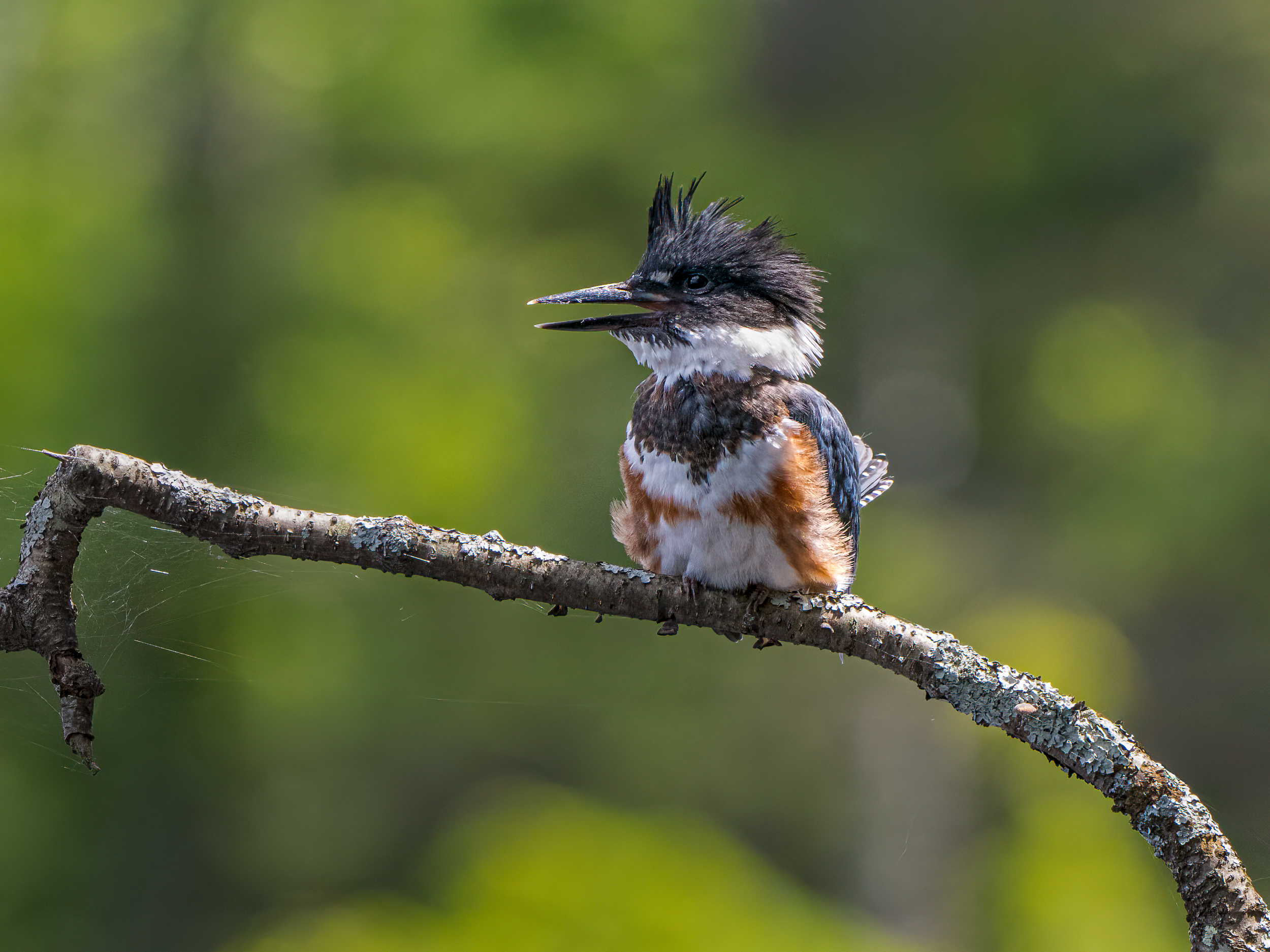
Lucky for me she hop/flapped to this other branch where she faced me directly! She never dove again, but was constantly vocalizing to her parents who were nearby as I could hear them answer her. They never graced me with their presence, though.

Just look at her sing! Happy in her exuberant life.

She was a joy to watch and listen to. Supremely confident in her safety which is something she will lose as she grows up. In my experience, young animals of most species are more tolerant than they are as adults. Some of my longest sessions with Great Blue Herons have been with juveniles and the only porcupine that didn’t try to run from me was a youngster. The light kept shifting and changing as the wind blew the trees around and I overexposed a bit sometimes. I was too excited and elated to be critical of my settings.

Challenges
Which leads me to what I don’t love about shooting from a kayak – the difficulty of maneuvering, positioning and composing. That and the near impossibility of being truly motionless. Yes, a kayak is freeing in some ways, but you can’t easily lock in compositions or make small adjustments to perspective or framing – everything takes a lot more time. Patience and knowing when to walk away from a shot (so to speak) is important. So many times I’ve found something interesting and just can’t get to it or frame it so it works. This goes for landscapes or photos of flowers and other foliage, but a lot of the time it’s wildlife or insects. Just as I get there – they leave. Just as I think the boat is still, it rocks. Just when I think I have a great reflection, the breeze kicks up. Often I find frustration and irritation roiling in my chest and when I do, I back off and think about why I’m really out here – for the experience and the joy of paddling in nature, not just the photos.
Which leads me to weather and opportunity. Wind is your enemy so anything that is steady above 5 mile-per-hour or gusts over 10 will be really hard going for photography and maybe just for paddling. Stiff winds are not fun for me so I hardly ever go out in them deliberately. Yes, I get caught in it now and then and have had to paddle hard for home, but mostly I avoid. Same with rain and especially thunderstorms – never a good idea to go out in a small boat in one of those. On days I do go out when I know it will be windy, photography takes an even more secondary position because I know it will be difficult and probably frustrating. Setting aside that goal makes me more relaxed and reduces my own expectations of producing something.
Which segues nicely to opportunity and outcomes. As photographers, we have plans, agendas, shot lists and grand intentions; which can mean bugger all to the conditions or circumstances. The day I took most of these photos and had that amazing time with Ms. Kingfisher, I was supposed to go somewhere else and was almost there when I saw something odd in the road. A leaf? A turtle? A bird? Turned out to be a Pine Warbler that had been hit by a car and left stunned and disoriented in the travel lane.
Since I volunteer with a local wildlife rehab facility, I had to take the little guy in since I couldn’t assess what kind of care it might require. That ate up another hour and since I needed as much time as possible at this remote lake, I decided to turn on a dime and go elsewhere. Sure I was a little disappointed, but not enough to risk the bird and endure the guilt. There will be another day for my original plan and I had a FANTASTIC time on Harrison Flowage. I may never have had another experience like I did with the lovely fledgling and so it was possibly an even better time than I might have had otherwise. Who knows, the point is to be flexible and enjoy what presents itself without second-guessing your decisions.
Yes, my photography is important, but so is being out in nature and enjoying the sights and sensations to be had. When I can’t get the shot I want, I either move to a new area and shake off the tendrils of failure, or I sit and wait for something else. Take this shot for example –

I’d noticed both the Ladybug and various Bluet damselflies all around and tried for photos of both, but failed because of the considerable breeze. So I just sat it out and enjoyed the buzzing, flying and calling all around me. The sun was warm, the air was fresh and what’s not to love? The Ladybug didn’t fly off and then a Bluet landed. It took me a few tries to get both of them sharp, but wonder of wonders, I managed it. Better together for sure. I just had to wait.
That’s another thing about kayaking that used to be a chore for me; the waiting. Being in a hurry won’t help you with photography in a boat and learning to be still with your senses open will reward you. Over time I’ve come to relish my solitary time on the water, parked, doing nothing except being in the moment with all the companions around me. This can be beneficial for doing stealth photography and taking your time picking out subjects and details. However, you still need to be quick on the draw sometimes –

I had inadvertently gotten VERY close to a Red-winged blackbird nest and this father wasn’t going to abandon his family. He perched right above the nest and glared at me severely. So close that this is barely cropped at 125mm focal length. Being ready got the shot as well as his fearlessness. That’s why I keep the long zoom on one camera body and the landscape lens on the other.
Lessons Learned
Ok, so I’ll give you list to make it easier
- Patience – it takes practice to move the boat quickly and accurately
- Be in the moment for itself
- Know when to let a photo go
- Patience – not every shot will come together, wind blows, animals move, it happens
- Be ready for what comes your way whether it’s slow or fast
- Pay attention to the weather
So that’s it for this paddling session. Stay tuned for more surprises on the water.

