
Amanita muscaria guessowii that’s who!
Even though I complained at the lack of mushrooms this year, I have enough to break out a post about this particular species. Last year I did a more encompassing Amanita post, but this time it’s just this one – Yellow fly agaric.
As I said in that post, Amanitas start out inside eggs that form at or just below the surface of the ground. This shot is as close as I’ve ever found them to the egg stage –

As they expand, bits of the universal veil that forms the egg stick to the cap and make patches called warts. Those are the white spots on the iconic mushroom image that shows up in almost every cartoon, illustration and even emojis (check your phone, I’ll wait).
🍄 – there it is!
I didn’t even notice the slug up there in the first photo until I got it into Lightroom. That might be what nibbled this next one –

As I warned in the other post, just because animals eat these mushrooms doesn’t mean you should. The toxins in the American species of Fly Agaric skew toward the poisonous rather than the merely hallucinogenic. They are basically the opposite in the European species, but neither should be eaten.
Here’s a look at the same species at a slightly later point in development. It’s amazing how different it looks. You’d think it was a another kind altogether, but it’s not. I’ve never come across an explanation for this variance in my reading. Maybe soil conditions or other fungi? Possibly it’s dependent on the types of trees or other plants around. Keeps things interesting that’s for sure.

I put this one at the top of the post because damn! It’s impressive. I don’t know that I’ve ever seen a more gigantic and beautiful example of this mushroom before. It literally stopped me in my tracks and I gave a silent thanks to the universe that the women ahead of me on the trail didn’t kick or step on it before I got there. This level of peak beauty and near-perfection doesn’t last more than a few days usually and so finding this one like this was a gift.
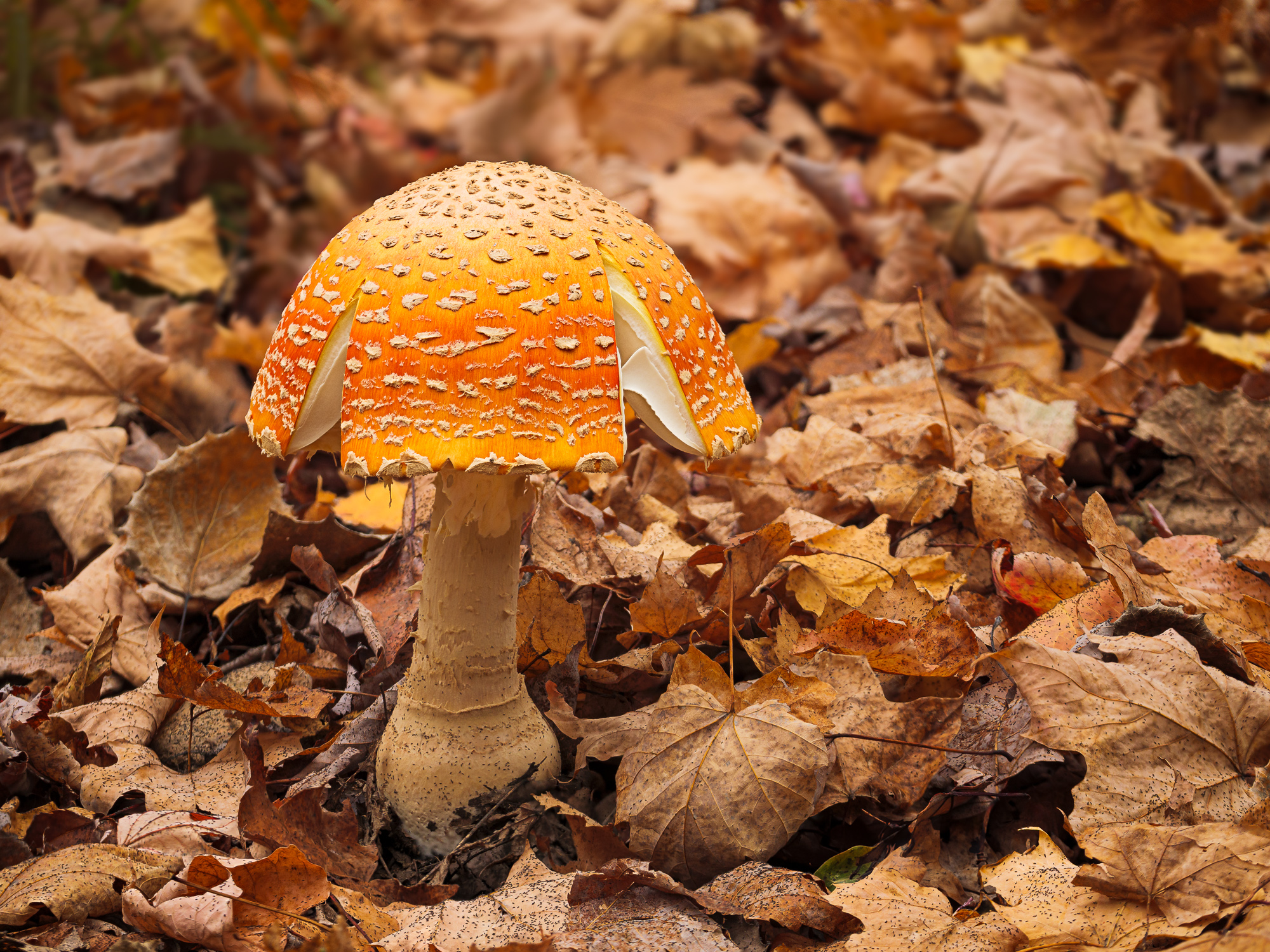
Check out the size of this thing!

Isn’t it gigantic? Seriously. I wanted to show some scale and what a better way than to just take a cell phone snap of my set up for this next photo. The way it split as the cap expanded provides a cool view to the interior of these impressive fruiting bodies. The white flap at the front is one of the gills that contains the spores. It’s ripped free and sits face on instead of side-by-side like the rest.

Here’s a shot that for me really shows how dappled sunlight on the forest floor is so magical. Not complaining when I get more even light since it is kind and works well for many subjects, but I was very glad the sun came out for a little while.

Not sure you can make them out in these photos, but the dark specks on the base of the stipe and the leaves just under the cap are springtails. At least I think they are. Springtails are sometimes called snow fleas because they mass like this on top of snow in warmer conditions. They are not really fleas nor are they insects – they’re arthropods and have their own subphylum called hexopoda. And weirdly, they don’t have tails. They moved around a lot and it was funny to see the different positions in the individual photos for the stack. I wonder if they eat the spores and that’s why they are here – waiting for the manna from heaven so to speak. Hm.

And here’s the next stage in the fruiting lifecycle –

That one was actually the first of the Amanitas that I found on the trail. There were a few others near it, but with lots of tangled growth around them. Thankfully this one was free of that and had a nice big boulder behind for a bit of a change to what was to come. I love the ragged bits of the partial veil hanging down in front and to the side. The partial veil covers the gills on the underside of the cap until it expands enough to tear it free. Then the spores can fall and fly to propagate the fungi.
And that ends my time with these fall beauties in the fallen leaves. By the time this posts, we may have snow on the ground as a new season approaches.


Thanks for the detailed explanation of the phases. I didn’t even notice the slug until you mentioned it and I’d never heard what causes the warts. Very interesting! I see these in my yard from time to time.
You’re very welcome. I’m glad it wasn’t too boring with all the info. Sometimes I get carried away!
These are just gorgeous, Kris! Also, I like the comparison of camera and mushroom for size. Years ago I was hiking at a higher elevation than where I lived in Colorado and came across a red amanita – in fact, a bunch of them, all scattered in a glade. They looked just like the ones fairies sit upon in old story books. If I recall, the cap had spread out and was quite flat, still curved down a bit, and had to be easily a hand span across in size (and my hand span is 8.5″ FYI!). And if they weren’t amanitas, they still looked like them . . . they were beautiful.
Thanks much. I almost didn’t take a photo for scale, but in the end I did. I think that the red variety of these is only west of the Mississippi with the yellow ones over this way. I’ve never seen the red ones IRL, but I want to. Maybe someday.